
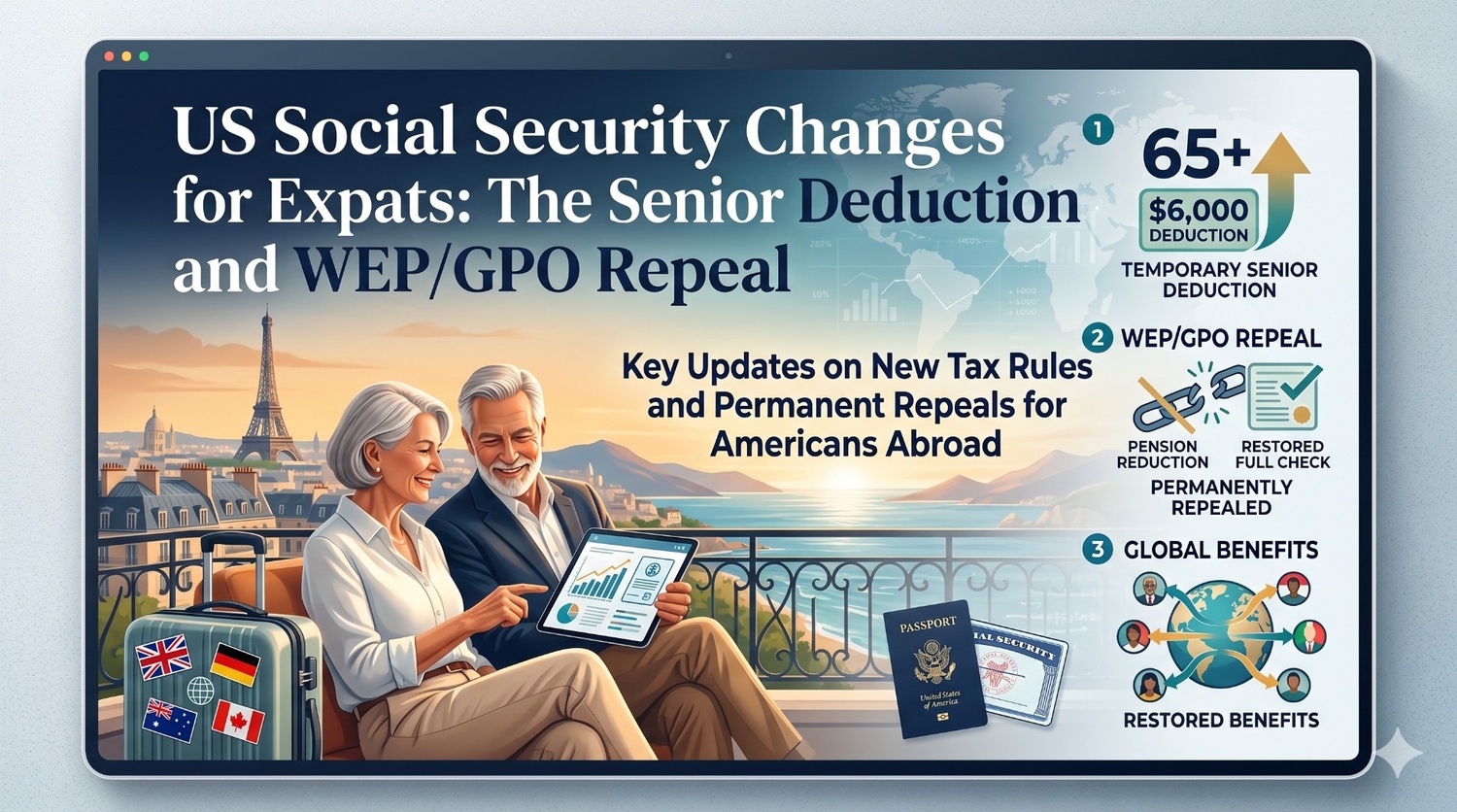
Recent legislative updates have significantly altered the Social Security landscape for American expatriates. While the One Big Beautiful Bill (OBBB) Act introduced a temporary tax deduction for seniors, a separate and more profound change occurred with the permanent repeal of the Windfall Elimination Provision (WEP) and the Government Pension Offset (GPO).
Despite a misleading email from the Social Security Administration (SSA) suggesting that federal taxes on benefits were eliminated entirely, the underlying tax rules remain in place. However, the combination of new deductions and long-standing expat tax protections means most expats will continue to owe $0 in US taxes on their benefits.
At a Glance: Key Changes for Expats
| Provision | Impact | Timeline / Limits |
| Senior Tax Deduction | Deducts up to $6,000 (single) or $12,000 (joint) from taxable income for those 65+. | Tax years 2025–2028; phases out above $75,000 MAGI ($150,000 MFJ). |
| WEP Repeal | Permanently eliminates Social Security benefit reductions for individuals receiving foreign pensions. | Effective Jan 2025 (Retroactive to Jan 2024). |
| GPO Repeal | Permanently eliminates reductions to spousal and survivor benefits caused by foreign pensions. | Effective Jan 2025 (Retroactive to Jan 2024). |
| Totalization Agreements | Unchanged; continues to prevent double Social Security taxation across 30+ countries. | Permanent. |
- What the OBBB Act Actually Means for Your Taxes
Enacted on July 4, 2025, the OBBB Act introduces a temporary tax deduction designed to reduce or entirely shield taxable income for qualifying seniors. It does not permanently eliminate the taxability of Social Security; up to 85% of your benefits remain potentially taxable under existing federal thresholds. Instead, it provides a generous buffer:
- Individual Filers (65+): A $6,000 deduction for those earning up to $75,000, phasing out completely at $175,000.
- Married Filing Jointly (65+): A $12,000 deduction for couples earning up to $150,000, phasing out completely at $250,000.
- Expiration: These provisions are set to expire at the end of 2028 unless extended by Congress.
Note: This deduction is strictly age-gated. Younger expats receiving Social Security Disability Insurance (SSDI) or survivor benefits do not qualify for this specific relief.
- The WEP and GPO Repeal: A Major Win for Expats
While the OBBB grabbed headlines, the permanent repeal of WEP and GPO in January 2025 is the far more impactful story for the expat community.
Previously, Americans who earned a pension from a foreign employer or government saw their US Social Security benefits drastically reduced. With these provisions eliminated, full benefits are restored. Furthermore, because the repeal is retroactive to January 2024, affected expats are receiving substantial lump-sum back payments.
Real-World Example: Sarah, a retired teacher living in France, saw her US Social Security benefit cut to $1,200 per month due to WEP rules. Following the repeal, her full monthly benefit of $1,650 was restored, and she received a lump-sum payment covering the withheld amounts dating back to January 2024.
- How Existing Expat Tax Protections Interact with Benefits
Even prior to the OBBB Act, the vast majority of expats owed no US tax on their Social Security due to structural tax mechanisms:
The Foreign Tax Credit (FTC)
If your host country taxes your US Social Security benefits, you can utilize the FTC to offset your US tax liability dollar-for-dollar. In high-tax jurisdictions (e.g., the UK, France, Germany), your foreign tax liabilities typically exceed what you would owe the IRS, reducing your US tax bill on these benefits to zero.
The Foreign Earned Income Exclusion (FEIE)
For expats who are still working while drawing Social Security, the FEIE allows you to exclude up to $130,000 (for tax year 2025) of earned income. By lowering your overall Adjusted Gross Income (AGI), your Social Security benefits are much less likely to trigger federal tax thresholds.
Tax-Exempt Destinations
Several popular retirement destinations—including Panama, Thailand, Malaysia, and parts of the Caribbean—do not tax US Social Security benefits at all. In these regions, the OBBB deduction offers an excellent secondary layer of US tax insulation.
- Fact-Checking the Confusing SSA Communication
In July 2025, the SSA issued an email stating that the OBBB “eliminates federal income taxes on Social Security benefits.” This phrasing was highly criticized by tax professionals and financial media outlets as inaccurate and misleading.
To clarify: The bill provides a temporary deduction, not an outright elimination. If you found the agency’s communication confusing, you were not alone; the fundamental tax brackets and thresholds remain active.
- Strategic Next Steps and Scenario Planning
Action Items Based on Age
- If you are 65 or older: Review your 2025 tax filings (submitted in 2026) to ensure the OBBB deduction is properly applied. If you were previously affected by WEP/GPO, verify that your monthly payouts have adjusted upward and look out for your retroactive lump-sum payment.
- If you are under 65: Ensure you are optimizing the FEIE and FTC. If you qualify for a foreign pension, note that the WEP/GPO repeal protects your future retirement calculations.
Pro Tip on Lump-Sum Payments: Large retroactive WEP/GPO distributions can inadvertently push you into a higher tax bracket for the year they are received. Speak with a cross-border tax specialist to determine if income-averaging or tax-straddling strategies can mitigate this one-time spike.
Impact by Expat Profile
- Corporate Expats in High-Tax Countries: Your tax position will likely remain unchanged, as your Foreign Tax Credits already eliminate US tax liabilities.
- Retirees in Low-Tax/No-Tax Countries: The OBBB deduction provides genuine, tangible savings by shielding your income from the IRS when foreign credits aren’t available.
- Digital Nomads: The OBBB deduction offers highly consistent, location-independent US tax relief as you transition between various international tax jurisdictions.
If you have fallen behind on your US tax obligations while living abroad, the IRS Streamlined Filing Compliance Procedures remain open, allowing you to catch up on back taxes and foreign asset disclosures with minimized penalties.