
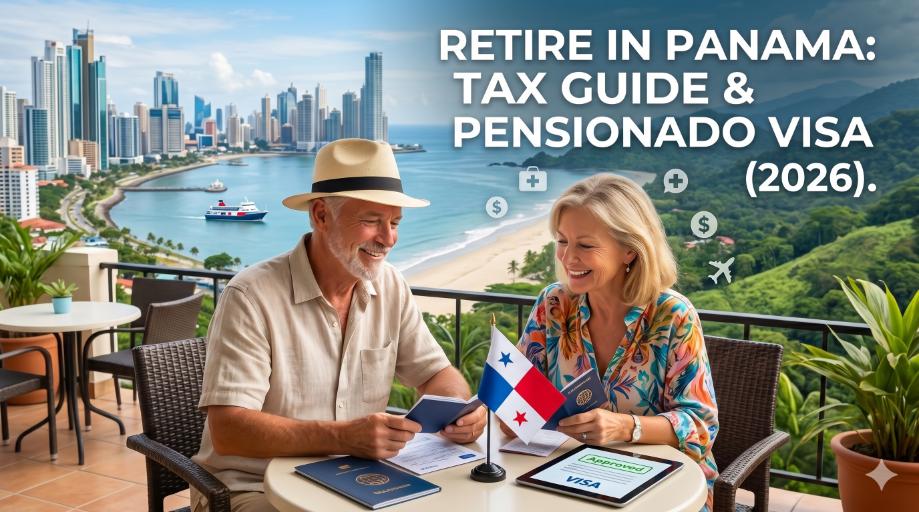
For American citizens planning their retirement, Panama remains one of the most financially advantageous destinations in the world. Due to robust US expat tax protections like the Foreign Earned Income Exclusion (FEIE) and Panama’s own welcoming tax policies, the majority of American retirees living in the country owe $0 in local taxes. Furthermore, Panama features the world-renowned Pensionado (Pensioner) visa program, which grants immediate permanent residency to individuals with a guaranteed monthly pension of just $1,000.
When combined with Panama’s territorial tax system—which completely exempts foreign-sourced income—relocating allows retirees to maximize their purchasing power while significantly minimizing, or entirely eliminating, their tax liabilities.
Why US Retirees Are Choosing Panama
Maximized Purchasing Power
The cost of living in Panama is approximately 50% lower than in the United States. A single retiree can live comfortably on $1,400 to $1,700 per month, while couples typically require between $2,000 and $3,000. Given that the average US Social Security benefit sits at roughly $1,827 per month, many expatriates find they can live entirely off their benefits while enjoying an upgraded quality of life.
Complete Exemption on Foreign Retirement Income
Panama operates on a strict territorial tax system, meaning the government only taxes income generated within its national borders. Consequently, your US Social Security, private pensions, and retirement account distributions (such as 401(k)s and IRAs) are completely exempt from Panamanian taxation.
High-Quality, Affordable Healthcare
Healthcare costs in Panama are 60% to 80% lower than US prices for comparable care. Premium private health insurance ranges from $50 to $900 per month, and English-speaking, Western-trained physicians are widely available in major expat hubs.
Navigating the Panama Pensionado Visa
The Pensionado visa grants immediate permanent residency to foreign retirees who meet straightforward financial criteria.
Core Eligibility Criteria
- Age: 18 or older (there is no maximum age cap).
- Income: A lifetime monthly pension or retirement income of at least $1,000.
- Property Reduction: The income requirement drops to $750 monthly if you invest a minimum of $100,000 in Panamanian real estate.
- Dependents: An additional $250 per month is required for each dependent.
- Background & Health: Applicants must provide a clean federal criminal background check and pass a local medical examination.
Eligible Income Sources
- US Social Security benefits
- Government pensions (military, federal, state, or municipal)
- Corporate or private company pensions
- Defined distributions from 401(k) plans or IRAs
Key Benefits and Discounts
The Pensionado visa offers some of the most generous, government-mandated senior discounts in the world, including:
- 50% off entertainment (movies, theaters, concerts, and sporting events)
- 25% off domestic airline tickets
- 20% off medical consultations and 15% off hospital bills
- 10% off prescription medications
- A one-time $10,000 tax exemption on the importation of household goods
- An import tax exemption on a new vehicle every two years
Residency Maintenance: To maintain permanent residency status, you are only required to visit Panama once every two years.
US Tax Obligations for Expats in Panama
Moving abroad does not eliminate your status as a US taxpayer. Because the United States utilizes citizen-based taxation, you must continue to file annual federal tax returns. However, double taxation is easily avoided through several key mechanisms.
The Foreign Earned Income Exclusion (FEIE)
If you choose to work or consult part-time during retirement, the FEIE allows you to exclude up to $130,000 of foreign earned income from US federal income tax (for the 2025 tax year, filed in 2026) via Form 2555.
- Consulting & Freelancing: Income generated from services performed while residing in Panama may qualify for the exclusion.
- Self-Employment Note: While the FEIE reduces income tax liability, it does not automatically eliminate US self-employment taxes unless an international totalization agreement applies.
The Foreign Tax Credit (FTC)
For income that cannot be excluded via the FEIE, the Foreign Tax Credit offers a dollar-for-dollar reduction on US tax liabilities based on taxes paid to a foreign government. However, because Panama does not tax foreign-source retirement income, retirees rarely need to utilize the FTC for their US retirement distributions.
US Taxation of Retirement Assets
| Asset Type | US Tax Treatment |
| Social Security | Up to 85% may be taxable depending on your Provisional Income. Many expats fall below the threshold where any tax is owed. |
| Traditional IRA / 401(k) | Withdrawals are taxed as ordinary income, though standard deductions frequently offset the actual tax liability. |
| Roth IRA / 401(k) | Distributions are 100% tax-free, provided you are over 59½ and the account has been open for at least 5 years. |
Top Retirement Destinations in Panama
Panama City: Urban Sophistication
Panama City offers a bustling metropolitan lifestyle featuring high-rise luxury condos, world-class dining, and ocean views. Neighborhoods like Punta Pacifica provide upscale, modern amenities, while El Cangrejo offers a more bohemian, walkable, and affordable environment with an active expat community.
- Average Budget (Couples): $2,500 – $4,000 per month
Coronado: Coastal Gated Community
Located just an hour and a half from the capital, Coronado is a premier Pacific beach town. It features resort-style living, pristine beaches, golf courses, and a highly organized, English-speaking expat network.
- Average Budget (Couples): $2,000 – $3,000 per month
Boquete: Mountain Highland Retreat
Nestled in the highlands of the Chiriquí Province, Boquete is famous for its cool, spring-like climate, lush mountain scenery, and coffee plantations. It hosts one of the largest concentrations of American retirees in Central America.
- Average Budget (Couples): $1,800 – $2,500 per month
Bocas del Toro: Caribbean Island Living
For those seeking a laid-back, eco-centric lifestyle, this Caribbean archipelago offers crystal-clear waters, water sports, and a distinct island culture.
- Average Budget (Couples): $1,500 – $2,200 per month
Critical Compliance and Tax Reporting
Failing to comply with US and international reporting requirements can result in steep financial penalties. Ensure you monitor the following obligations:
Annual IRS Tax Returns
You must file a US federal income tax return every year, regardless of whether you reside abroad or owe zero taxes. For expats, compliance is a matter of administrative reporting rather than an actual financial liability.
FBAR (FinCEN Form 114)
If the aggregate balance of all your foreign bank accounts exceeds $10,000 at any point during the calendar year, you must file a Foreign Bank Account Report (FBAR). The filing deadline is April 15, with an automatic extension to October 15.
Corporate Asset Structuring (Form 5471)
Many expats choose to purchase Panamanian real estate through a local corporation (Sociedad Anónima) for asset protection and estate planning. If you hold a controlling interest in a foreign corporation, you must file IRS Form 5471. Failure to file this form carries a strict minimum penalty of $10,000 per year.
Case Study: A Realistic Tax Scenario
Meet Bob and Carol
A retired married couple living in Boquete.
- Social Security Income: $3,400/month ($40,800/year)
- Traditional IRA Distributions: $1,600/month ($19,200/year)
- Total Annual Gross Income: $60,000
The Financial Outcome: > After applying the standard deduction for a married couple filing jointly, alongside standard Social Security tax exemptions, their US taxable income is dramatically reduced. Ultimately, Bob and Carol owe between $0 and $300 in US federal income taxes, allowing them to live a premium lifestyle while retaining nearly 100% of their retirement wealth.
Your Relocation Timeline
12 Months Out: Discovery & Assessment
- Conduct a scouting trip to Panama to evaluate different microclimates and regions.
- Gather certified proof of your pension or retirement income from the relevant US agencies.
- Evaluate private international health insurance policies.
- Consult a cross-border certified public accountant (CPA) to optimize your asset distributions.
6 Months Out: Logistics & Legalities
- Retain a registered Panamanian immigration attorney to formalize your Pensionado application.
- Establish a secure US-based mail forwarding and scanning service.
- Notify your US financial institutions of your upcoming international relocation to avoid fraud alerts.
Arrival & Onboarding
- Finalize your residency application with your attorney to secure your Carné de Residente (residency card).
- Open a local Panamanian bank account to satisfy ongoing residency maintenance requirements.
- Secure local healthcare providers and register with regional expat networks for community support.
Summary: Weighing the Pros and Cons
Advantages
- Affordability: A substantially reduced cost of living relative to the US.
- Tax Optimization: Access to a territorial tax regime coupled with foreign tax exclusions.
- Exceptional Healthcare: World-class medical infrastructure at a fraction of domestic costs.
- Safety & Stability: A politically secure environment with a dollarized economy.
Considerations
- Language Barrier: While English is common in expat enclaves, basic Spanish is highly beneficial for daily life.
- Bureaucracy: Local administrative processes operate at a slower, traditional Latin American pace (mañana culture).
- Infrastructure Variations: While major cities and hubs feature modern infrastructure, rural and island regions may experience occasional utility or internet disruptions.